Astronomers release best measurements of galaxy temperatures, star formation yet
November 5, 2025
November 5, 2025
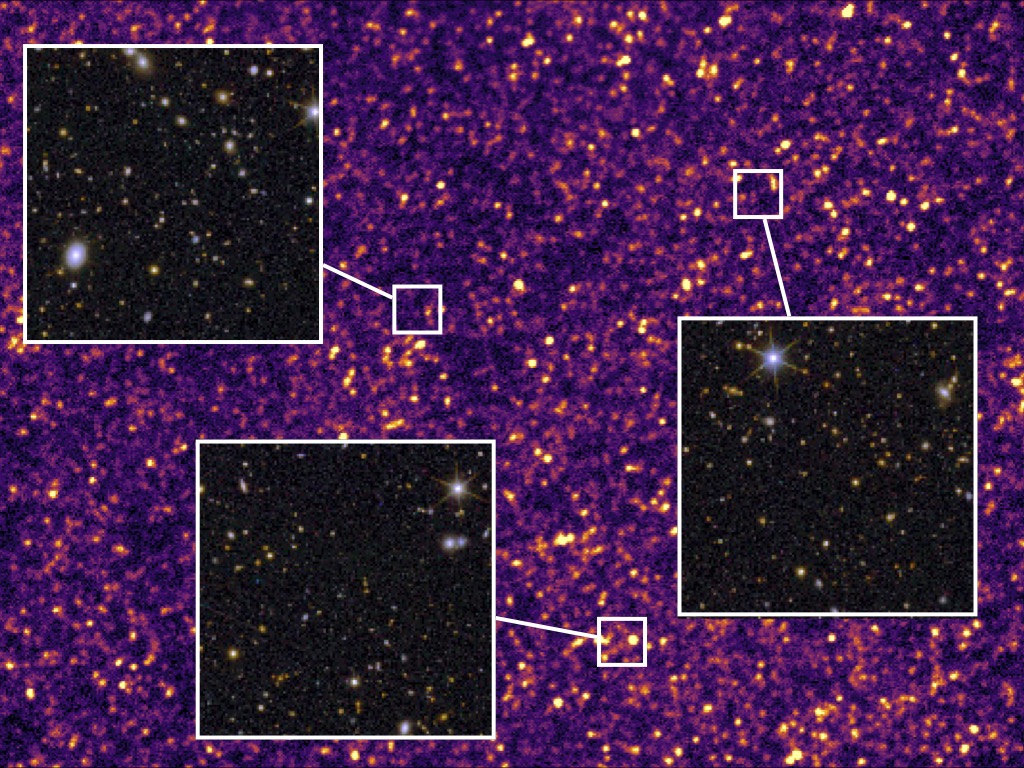
Astronomers have released a sneak peak of the most accurate measurements yet of key aspects of the Universe, including star formation rates and the average temperature of galactic stardust.
The data release and analysis, based on the largest sample of galaxies so far, combines optical measurements from the Euclid mission and measurements at longer wavelengths (far-infrared) from the Herschel satellite.
“By combining the data and having such a huge sample of galaxies—2.6 million of them—we can produce the most statistically robust calculations to date,” says University of British Columbia (UBC) researcher Dr. Ryley Hill, who led the data analysis and is first author of a paper outlining the results, now available in preprint.
“In the past, researchers wouldn’t have a large enough sample, or might be missing key populations of cold or hot galaxies. Since Euclid is so comprehensive, you can really measure dust temperatures in a way you can’t argue with.”
Average dust temperatures in the galaxies haven’t been changing much—they were about 10 degrees hotter ten billion years ago. In the early days of the Universe, dust temperatures were as hot as 35 Kelvin, or -238 Celsius. That may not seem very hot, but it represents the average temperature throughout entire galaxies, which are mostly empty space.
Star formation is a complex process that scientists are still working to understand fully. One well-understood idea is that the temperature of galactic dust is directly linked to the rate of star formation in a given galaxy, which is supported by the new results. Galaxies with higher star formation rates tend to have hotter dust because they contain more massive, hotter stars.
And on that front, the new results confirm that the Universe is already past its prime.
“The Universe will just get colder and deader from now on,” notes Dr. Douglas Scott, a cosmologist at UBC and author on the preprint. “The amount of dust in galaxies and their dust temperatures have been decreasing for billions of years, which means we’re past the epoch of maximum star formation. Dust grains are connected with star formation, and when stars burn up, they make a whole bunch of dust grains in the process.”
Galaxies are the building blocks of structure in the Cosmos—there are billions of galaxies in the known Universe, each containing stars and planets. Precise data helps researchers better understand how they form and evolve over time. It also helps them dig into the nature of dark energy, dark matter and gravity.
The team—which included 175 Euclid Collaboration members—used the improved data together with existing Herschel satellite data at much longer wavelengths to estimate the average dust and star formation properties for millions of galaxies.
Euclid has already surveyed an area 30 times larger than the images that these results are based on. The Euclid mission will continue to collect data and survey more of the extragalactic sky over the coming years, and the team is extracting more precise information about galaxies, as well as using them to probe the nature of dark matter and dark energy.
About the Euclid Mission
Euclid is a 1.2-metre space telescope designed to create the most accurate 3-D map of the Universe on large scales and shed light on dark matter and dark energy. The mission is led by the European Space Agency (ESA) in partnership with Canada and other countries. Euclid will observe billions of galaxies and study how the Universe expanded and how structures evolved over time.
November 19, 2025
New imaging technology from UBC captures genomic medicine delivery in action, opening up avenues for drug discovery and testing. read more

October 28, 2025
New results from an international team including UBC astrophysicists highlight the first black hole observed to be spinning in a direction opposite its orbit. read more

September 10, 2025
Scientists celebrate the anniversary of the first gravitational wave ever detected with new resultsA decade after the groundbreaking detection of gravitational waves, an international team, including researchers from the University of British Columbia, has observed the loudest black hole merger to… read more
We honour xwməθkwəy̓ əm (Musqueam) on whose ancestral, unceded territory UBC Vancouver is situated. UBC Science is committed to building meaningful relationships with Indigenous peoples so we can advance Reconciliation and ensure traditional ways of knowing enrich our teaching and research.
Learn more: Musqueam First Nation