Pair of distinct black hole mergers sheds new light on their formation and evolution
October 28, 2025
October 28, 2025
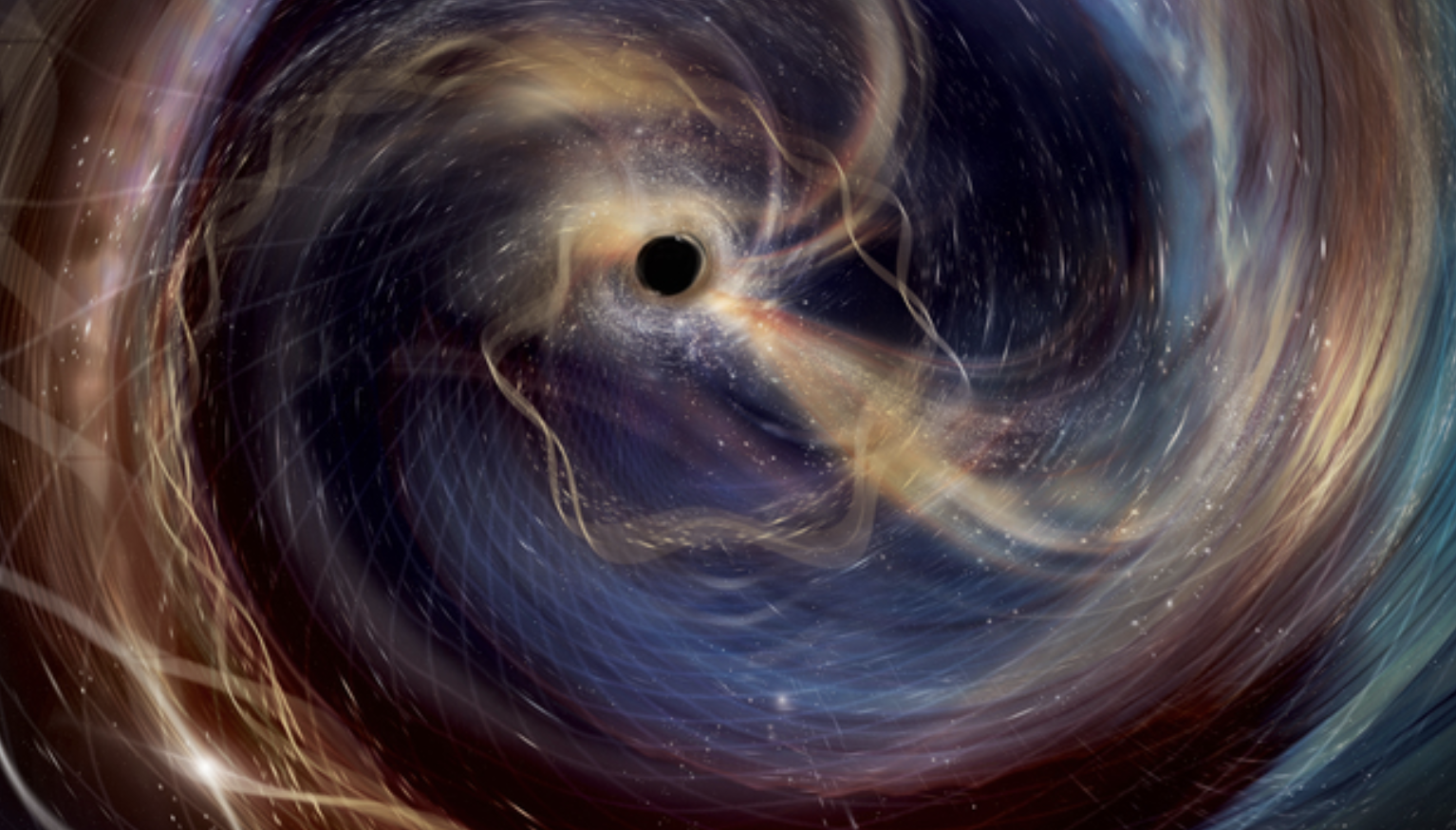
A pair of distant cosmic black hole mergers, measured just one month apart in late 2024, is improving how scientists understand the nature and evolution of the most violent deep-space collisions in our universe. Data collected from the mergers also validates with unprecedented accuracy fundamental laws of physics that were predicted more than 100 years ago by Albert Einstein and furthers the search for new and still unknown elementary particles with the potential to extract energy from black holes.
In a new paper published in The Astrophysical Journal Letters, the international LIGO-Virgo-KAGRA Collaboration—including astrophysicists from the University of British Columbia—reports on the detection of two gravitational wave events with unusual black hole spins.
“This is one of our most exciting discoveries so far,” says Dr. Jess McIver, an astrophysicist at the University of British Columbia (UBC) and paper co-author. “It’s clear evidence that the origin of cosmic collisions detected by LIGO and Virgo is not as simple as stars that are born, live and die together. These events provide strong evidence that there are very dense, busy pockets of the Universe driving some dead stars together.”
The first merger detected, GW241011 (October 11, 2024), occurred roughly 700 million light years away and resulted from the collision of two black holes weighing in at around 20 and six times the mass of our sun. The larger of the black holes in GW241011 was measured to be one of the fastest rotating black holes observed to date.
Almost one month later, GW241110 (November 10, 2024) was detected around 2.4 billion light years away and involved the merger of black holes roughly 17 and eight times the mass of our sun. While most observed black holes spin in the same direction as their orbit, the primary black hole of GW241110 was noted to be spinning in a direction opposite its orbit – a first of its kind.
“Each new detection provides important insights about the universe, reminding us that each observed merger is both an astrophysical discovery but also an invaluable laboratory for probing the fundamental laws of physics,” says paper co-author Dr. Carl-Johan Haster, assistant professor of astrophysics at the University of Nevada, Las Vegas (UNLV). “Binaries like these had been predicted given earlier observations, but this is the first direct evidence for their existence.”
Gravitational waves are ‘ripples’ in space-time that result from cataclysmic events in deep space, with the strongest waves produced by the collision of black holes. They were first predicted by Albert Einstein as part of his general theory of relativity in 1916, but their presence – though proven in the 1970s – wasn’t directly observed by scientists until just 10 years ago when the LIGO observatory confirmed detection of the waves as the result of a black hole merger.
Today, LIGO-Virgo-KAGRA is a worldwide network of advanced gravitational-wave detectors and is in the midst of its fourth observing run, O4. The current run started in late May 2023 and is expected to continue through mid-November of this year. To date, approximately 300 black hole mergers have been observed through gravitational waves, including candidates identified in the ongoing O4 run.
Researchers at UBC play a central role in LIGO-Virgo-KAGRA results through analysis of LIGO data, including key contributions to calibration of LIGO data used by thousands of researchers worldwide. UBC's expertise in mitigating LIGO detector noise allows researchers to dig subtle signatures that can tell us about how these systems form out of noisy detector data.
Together, the detection of GW241011 and GW241110 highlight the remarkable progress of gravitational-wave astronomy in uncovering the properties of merging black holes. Interestingly, both detected mergers point toward the possibility of “second-generation” black holes.
"GW241011 and GW241110 are among the most novel events among the several hundred that the LIGO-Virgo-KAGRA network has observed,” says Stephen Fairhurst, professor at Cardiff University and spokesperson of the LIGO Scientific Collaboration. “With both events having one black hole which is both significantly more massive than the other and rapidly spinning, they provide tantalizing evidence that these black holes were formed from previous black hole mergers."
Scientists point to certain clues, including the size differential between the black holes in each merger – the larger was nearly double the size of the smaller – and the spin orientations of the larger of the black holes in each event. A natural explanation for these peculiarities is that the black holes are the result of earlier coalescences. This process, called a hierarchical merger, suggests that these systems formed in dense environments, in regions like star clusters, where black holes are more likely to run into each other and merge again and again.
"These two binary black hole mergers offer us some of the most exciting insights yet about the earlier lives of black holes,” said Dr. Thomas Callister, co-author and assistant professor at Williams College. ”They teach us that some black holes exist not just as isolated partners but likely as members of a dense and dynamic crowd. Moving forward, the hope is that these events and other observations will teach us more and more about the astrophysical environments that host these crowds."
The precision with which GW241011 was measured also allowed key predictions of Einstein’s theory of general relativity to be tested under extreme conditions.
Because GW241011 was detected so clearly, it can be compared to predictions from Einstein’s theory and mathematician Roy Kerr’s solution for rotating black holes. The black hole’s rapid rotation slightly deforms it, leaving a characteristic fingerprint in the gravitational waves it emits. By analyzing GW241011, the research team found excellent agreement with Kerr’s solution and verified Einstein’s prediction with unprecedented accuracy.
Additionally, because the masses of the individual black holes differ significantly, the gravitational-wave signal contains the “hum” of a higher harmonic – similar to the overtones of musical instruments, seen only for the third time ever in GW241011. One of these harmonics was observed with superb clarity and confirms another prediction from Einstein’s theory.
December 2, 2025
UBC scientists have demonstrated a reversible way to switch the topological state of a quantum material using mechanisms compatible with modern electronics. read more
November 19, 2025
New imaging technology from UBC captures genomic medicine delivery in action, opening up avenues for drug discovery and testing. read more
November 5, 2025
UBC astronomers release a sneak peak of the most accurate measurements yet of key aspects of the Universe, including star formation rates. read more
We honour xwməθkwəy̓ əm (Musqueam) on whose ancestral, unceded territory UBC Vancouver is situated. UBC Science is committed to building meaningful relationships with Indigenous peoples so we can advance Reconciliation and ensure traditional ways of knowing enrich our teaching and research.
Learn more: Musqueam First Nation