‘Loudest’ black hole ever detected, 10 years after Nobel-winning discovery
September 10, 2025
September 10, 2025
Scientists celebrate the anniversary of the first gravitational wave ever detected with new results
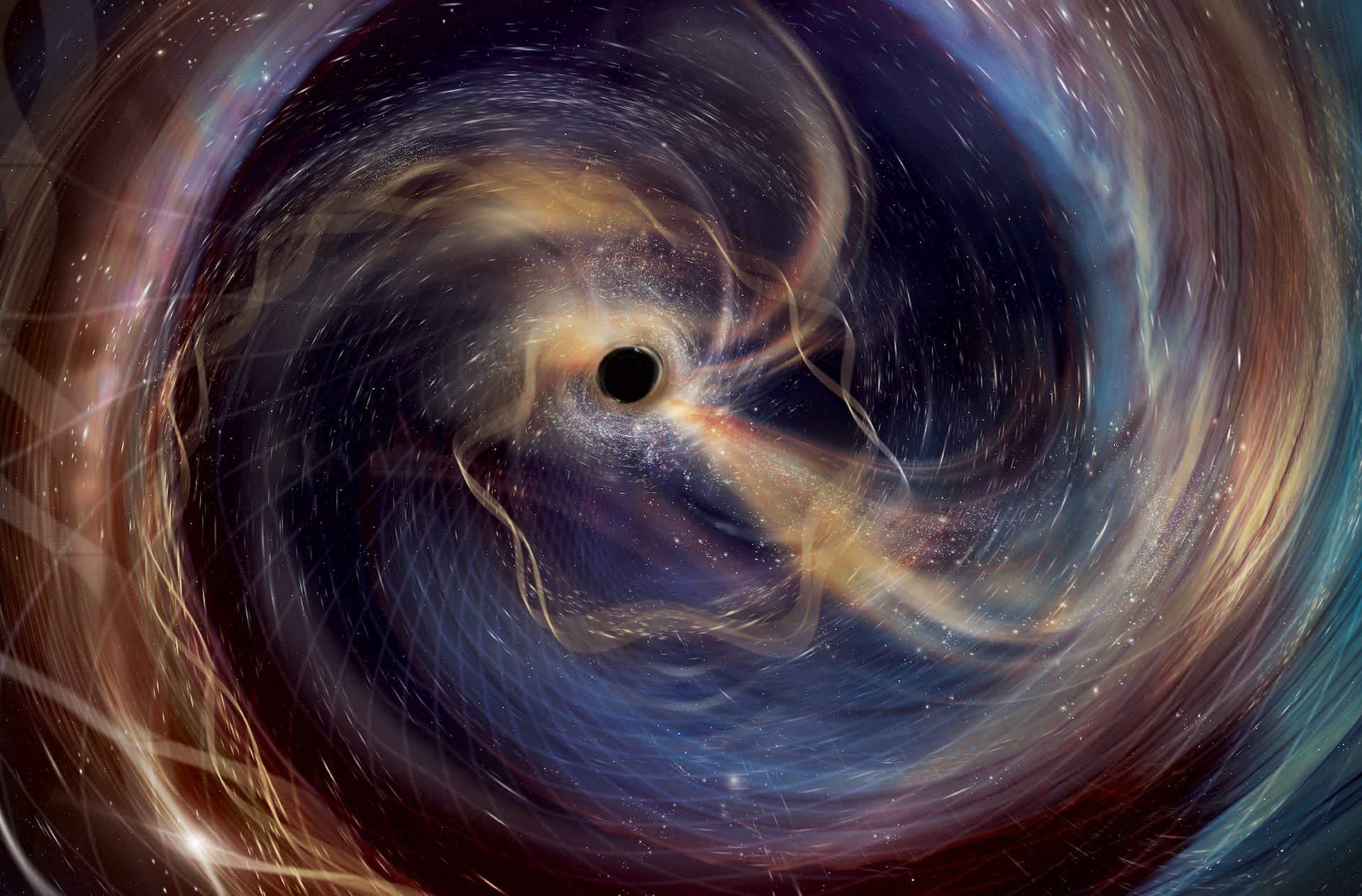
A decade after the groundbreaking detection of gravitational waves, an international team, including researchers from the University of British Columbia, has observed the loudest black hole merger to date.
The signal was three times stronger than the original 2015 detection that earned the Nobel Prize in Physics.
The discovery was made with the global gravitational wave network: the Laser Interferometer Gravitational-Wave Observatory (LIGO) in the U.S., the Virgo gravitational-wave detector in Italy and Kamioka Gravitational Wave Detector (KAGRA) in Japan.
“This not only means we are accelerating the rate at which we discover new black holes but also capturing detailed data that expand the scope of what we know about the fundamental properties of black holes,” says collaboration member Dr. Katerina Chatziioannou, Caltech assistant professor of physics and co- author of the study published in Physical Review Letters.
UBC researchers played a key role in refining LIGO’s data, effectively improving the reach of these remarkable instruments. “This is the strongest and cleanest signal we’ve received yet which allows us to test general relativity with very fine precision. Turns out, Einstein is still right,” says co-author Dr. Rhiannon Udall, postdoctoral researcher in the UBC department of physics and astronomy.
The first gravitational wave detection in 2015 confirmed Einstein’s century-old prediction that massive accelerating objects, like colliding black holes, warps the fabric of space itself, rippling outward as gravitational ‘waves’. These waves, and the black hole mergers that create them, cannot be seen with conventional telescopes.
Since then, the LIGO- Virgo-KAGRA collaboration has captured around 300 black hole mergers.
The latest signal arrived at LIGO’s two gravitational wave detectors simultaneously in January.
Like the 2015 event, this signal originated from two colliding black holes about 1.3 billion light-years away, each roughly 30 to 40 times the mass of the sun. Thanks to 10 years of technological advances, the signal was sharper and clearer than any previous detection. Researchers describe the event as the “loudest” black hole merger ever detected, referring to the signal’s strength and clarity, as gravitational-waves do not produce sound waves.
The researchers achieved this signal strength in part by reducing noise, including from the Earth itself. “A lot of seismic noise is waves of the ocean beating against the land. A bad day is when there’s storms in Greenland and the ocean is very active,” said Dr. Udall.
This improved technology has also caught the eye of geologists interested in the data captured from sensitive ground motion sensors used to help isolate LIGO’s instruments from earthquakes and traffic vibrations.
Quantum noise has been reduced using a technique called “squeezing”. “What we are ultimately doing inside LIGO is protecting quantum information and making sure it doesn’t get destroyed by external factors,” says co-author Dr. Nergis Mavalvala says, MIT professor. “The techniques we are developing are pillars of quantum engineering and have applications across a broad range of devices, such as quantum computers and quantum sensors.”
In collaboration with UBC’s Blusson Quantum Matter Institute, the UBC LIGO collaborators will develop new materials to further minimize atomic vibrations in detector mirrors. “This instrument is so advanced, we’re now hunting down even these tiny sources of noise,” said Taylor Starkman, UBC PHAS master’s student.
The LIGO-Virgo-KAGRA collaboration hopes to further fine-tune their machines and expand their reach deeper into space. “A global network of high-performing detectors gives gravitational waves a unique ability to advance a number of fields such as general relativity and nuclear physics, in ways that are otherwise impossible,” said co-author Dr. Jess McIver, UBC associate professor of physics and astronomy.
November 5, 2025
UBC astronomers release a sneak peak of the most accurate measurements yet of key aspects of the Universe, including star formation rates. read more

October 28, 2025
New results from an international team including UBC astrophysicists highlight the first black hole observed to be spinning in a direction opposite its orbit. read more
June 16, 2025
Can chemical ingredients for life evolve in space and transfer to forming planets? UBC astrochemists are mimicking the cold confines of deep space in the lab. read more
We honour xwməθkwəy̓ əm (Musqueam) on whose ancestral, unceded territory UBC Vancouver is situated. UBC Science is committed to building meaningful relationships with Indigenous peoples so we can advance Reconciliation and ensure traditional ways of knowing enrich our teaching and research.
Learn more: Musqueam First Nation