On-demand electronic switching of topology in a single crystal
December 2, 2025
December 2, 2025
University of British Columbia (UBC) scientists have demonstrated a reversible way to switch the topological state of a quantum material using mechanisms compatible with modern electronic devices. Published in Nature Materials, the study offers a new route toward more energy efficient electronics based on topologically protected currents rather than conventional charge flow.
“Conventional electronics involve currents of electrons that waste energy and generate heat due to electrical resistance. Topological currents are protected by symmetry, and so they are promising for new types of electronics with significantly less dissipation,” said Dr. Meigan Aronson, an investigator with UBC’s Stewart Blusson Quantum Matter Institute and the Department of Physics and Astronomy.
“Our research uncovers a specific mechanism where the addition or subtraction of electrical charge can drive a reversible topological transition in the crystal, switching it from a metal that can conduct charge to an insulator that can’t. This is a key step towards the implementation of a new type of low-dissipation electronics based on symmetry and topology, and not simply on charge.”
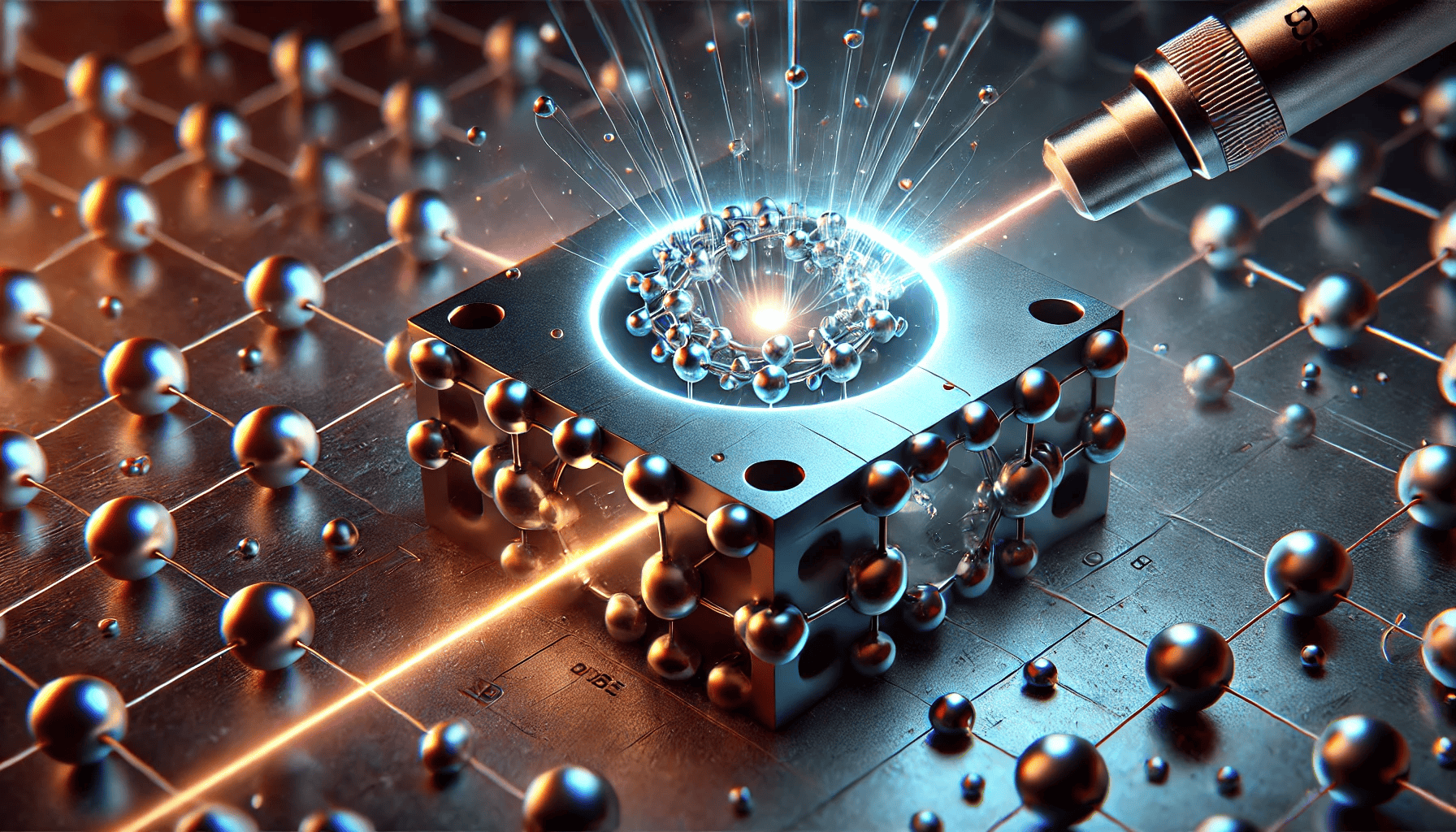
The team achieved full experimental control over the material’s topological “nodal loop”, which functions as a circular high-conductivity channel for electrons. When the atomic lattice maintains a precise symmetry, the loop remains open, allowing electrons to move freely. When that symmetry is disrupted, the loop breaks and a large energy gap appears.
“There are a lot of theoretical predictions about how symmetry affects electronic properties, but to verify the predictions in experiments, we need to be able to controllably break the relevant symmetries and see how the properties change. What excites me most about our work is that we have a material that allows us to reproducibly manipulate the symmetry of the crystal structure at will,” said Dr. Joern Bannies, the study’s first author and former PhD researcher at UBC Blusson QMI.
The researchers identified two knobs that control the transition. Modifying the antimony Sb to tellurium Te ratio in the crystal changes the electron count and alters the crystal’s lattice arrangement. They then demonstrated this process is reversible by depositing a thin layer of potassium on the surface of the crystal, which donates electrons and restores the symmetry required to close the energy gap in the nodal loop. That allows the topological currents to flow again. Heating the sample removes the potassium and returns the material to its original state, effectively creating an electronic switch similar to that used in transistors.
“The fact that adding just a few electrons to this material moves atoms selectively around is pretty cool. We repeated the potassium addition experiments many times to make sure the switching was not a one-time coincidence, and we always observed the switching behaviour,” Dr. Bannies said.
The team used Angle-Resolved Photoemission Spectroscopy (ARPES) to map how the electronic structure changed as the energy gap in the nodal loop opened and closed. The technique provides a direct measurement of electron energy and momentum, giving researchers a real-time view of the quantum transition.
“ARPES was absolutely central to this study. It’s the only technique that allows direct visualization of the electronic structure as the electrons quite literally appear on the screen, and you can observe their behaviour evolving in real time,” said senior research associate Dr. Matteo Michiardi. “With ARPES, we were able to track the complex transformation of the electronic topology step by step as we induced it.”
By showing that the electronic topology of a material can be tuned by adding or removing electrons, the study opens new possibilities for seamlessly integrating emerging quantum materials technology with established electronics.
This work was made possible through advanced beamline infrastructure at the Quantum Material Spectroscopy Center (QMSC) at the Canadian Light Source (CLS).
This research received funding from the Max Planck-UBC-UTokyo Centre for Quantum Materials, the Canada First Research Excellence Fund, and the Natural Sciences and Engineering Research Council of Canada.
November 19, 2025
New imaging technology from UBC captures genomic medicine delivery in action, opening up avenues for drug discovery and testing. read more
November 5, 2025
UBC astronomers release a sneak peak of the most accurate measurements yet of key aspects of the Universe, including star formation rates. read more

October 28, 2025
New results from an international team including UBC astrophysicists highlight the first black hole observed to be spinning in a direction opposite its orbit. read more
We honour xwməθkwəy̓ əm (Musqueam) on whose ancestral, unceded territory UBC Vancouver is situated. UBC Science is committed to building meaningful relationships with Indigenous peoples so we can advance Reconciliation and ensure traditional ways of knowing enrich our teaching and research.
Learn more: Musqueam First Nation