Orcas and dolphins seen hunting together for the first time
December 11, 2025
December 11, 2025
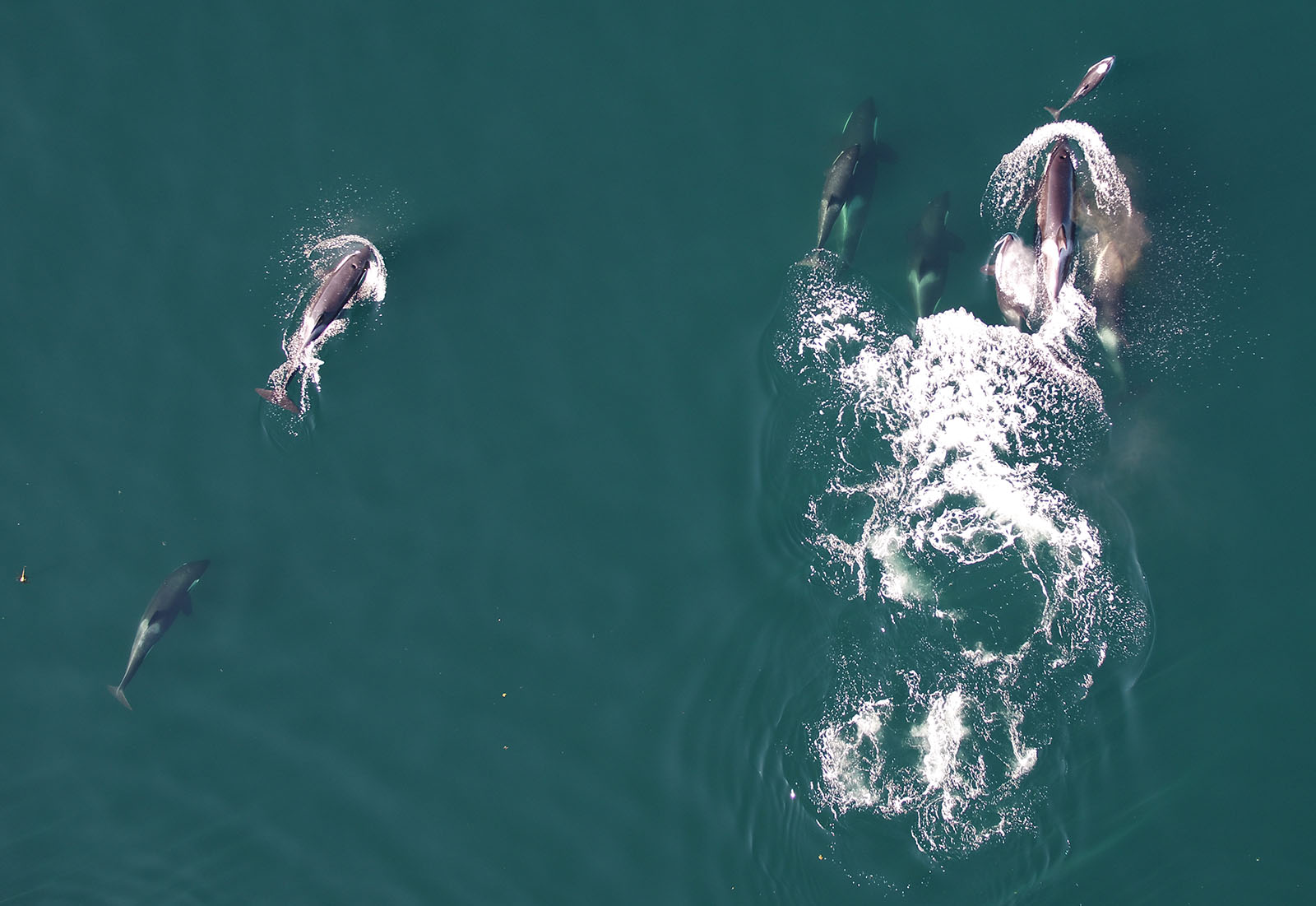
A new study has revealed that two top ocean predators—northern resident killer whales and Pacific white-sided dolphins—join forces to find and feast on salmon off B.C., with the first video of its kind showing the two species hunting for food and suggesting they have forged a co-operative relationship that may provide mutual benefits.
The paper, published today in the journal Scientific Reports, was undertaken by researchers from UBC, Dalhousie University, the Leibniz Institute and the Hakai Institute, and shows that these interactions are not just chance encounters. Instead, the species appear to be working together to hunt Chinook salmon in waters off B.C., where they are often seen within metres of each other.
"We've long known that resident killer whales interact with Pacific white-sided dolphins, but seeing them dive and hunt in sync with dolphins completely changes our understanding of what those encounters mean," said lead author Dr. Sarah Fortune, Canadian Wildlife Federation Chair in Large Whale Conservation and assistant professor in Dalhousie's oceanography department.
"Our footage shows that killer whales and dolphins may actually be cooperating to find and share prey—something never before documented in this population."
Using drones launched by the Hakai Institute and suction-cup biologging tags that later fell off, researchers captured remarkable aerial and underwater footage of the animals' co-ordinated interactions.
The observations showed that the two species frequently foraged in close proximity and often synchronized their movements. Killer whales were seen orienting toward dolphins and following them to depth, suggesting the whales were eavesdropping and using dolphin echolocation cues to help locate the large salmon—prey that dolphins cannot capture and swallow whole.
"The strategic alliance we observed between the dolphins and killer whales is extraordinary," said senior author Dr. Andrew Trites, a professor and director of the Marine Mammal Research Unit at UBC's Institute for the Oceans and Fisheries.
The videos reveal that once whales caught their prey and broke them apart into smaller pieces to share with other killer whales, the dolphins were quick to scavenge the leftovers.
"By working together, killer whales can conserve energy and use the dolphins as radar-equipped scouts to increase their chances of finding large Chinook salmon at deeper depths. In return, the dolphins gain predator protection and access to scraps from one of the ocean's most prized fish. It's a win-win for everyone involved."
Keith Holmes, a drone pilot with the Hakai Institute, first spotted the behaviour by chance during fieldwork for a UBC-led project. "From above you could see this incredible amount of activity. It was clear that there was some sort of communication happening and they were actively foraging together."
The team, which conducted the work in the north island waters of Vancouver Island in August 2020, used long carbon fibre poles to temporarily attach suction-cup tags to whales they identified by their unique markings, with only animals in good health that also weren't pregnant or lactating, selected for tagging.
It was the first time Customized Animal Tracking Solutions Tags (CATS) were used on whales and allowed the researchers to collect 3D kinematic data with video and acoustics, continuously recording high-resolution dive data, along with vocalizations and feeding-related sounds.
The researchers recorded 258 unique events of dolphins traveling near the head of tagged killer whales. All of the whales that interacted with dolphins engaged in foraging-related behaviours, such as killing, eating and searching for the salmon. Notably, the two species showed no signs of aggressive or avoidant behaviour.
The findings highlight the ecological significance of interspecies associations and the potential role they play in shaping marine food webs and helping predators adapt in a changing ocean. The researchers say further investigation is needed to understand how widespread and consistent such co-operative behaviours may be.
"By combining aerial and underwater information, we're uncovering a hidden layer of coordination between species," said Dr. Fortune. "It's a striking example of how new technology is helping us rethink the relationship between top predators in the ocean."

October 23, 2025
Fall rains have returned and mushrooms are emerging across B.C. Mycologist Dr. Monika Fischer on how fire-loving shrooms help forests recover from wildfires. read more

August 26, 2025
UBC astrophysicists are part of an international collaboration that has just unveiled 128 new significant gravitational wave signal candidates. read more
We honour xwməθkwəy̓ əm (Musqueam) on whose ancestral, unceded territory UBC Vancouver is situated. UBC Science is committed to building meaningful relationships with Indigenous peoples so we can advance Reconciliation and ensure traditional ways of knowing enrich our teaching and research.
Learn more: Musqueam First Nation