News
-
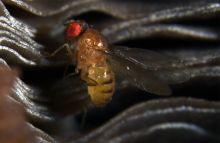
First chromosome that cheats in both sexes identified in fruit flies
May 9, 2025
Some genes just don’t play fair.Researchers have uncovered a ‘selfish’ X chromosome in the fruit fly Drosophila testacea that manages to distort inheritance in both sperm and eggs. “Researchers have known about these selfish genes in males for nearly 100 years, and they've become textbook… read more
-

A digestive ‘treasure chest’ shows promise for targeted drug treatment in the gut
May 1, 2025
A new approach to drug design can deliver medicine directly to the gut in mice at significantly lower doses than current inflammatory bowel disease treatments.The proof-of-concept study, published today in Science, introduced a mechanism called ‘GlycoCaging’ that releases medicine exclusively to… read more
-

Supports for the UBC community
April 27, 2025
Our thoughts are with the Filipino community and everyone affected by the tragedy in Vancouver. Supports are available for UBC students, faculty and staff. read more
-

We still have a representation problem for women in physics – and Canada is no exception
April 25, 2025
Fewer than one in 10 senior authors in a prestigious physics journal are women, according to a new study.Of 15 countries, Canada has the worst record. The 33 Canadian-led papers in Nature Physics in the last 10 years had zero senior authors who were women, according to a new study published by the… read more
-

From insulators to metals: spin chains enter uncharted quantum regime
April 22, 2025
The compound—Ti₄MnBi₂—becomes only the second known metallic system with confirmed one-dimensional magnetism.A study by researchers from the University of British Columbia’s Blusson Quantum Matter Institute (UBC Blusson QMI) has found a rare form of one-dimensional quantum magnetism in the metallic… read more
-

Visionary: Celebrating the legacy of a B.C. biotech pioneer
April 14, 2025
‘Peripheral vision’ helped Dr. Julia Levy co-found one of UBC’s most successful spinouts. The renowned immunologist passed away in December. read more
-

A Q+A with UBC’s new Dean of Science, chemist Mark MacLachlan
April 2, 2025
Dr. Mark MacLachlan, Canada Research Chair in Supramolecular Materials and the new Dean of Science at UBC, discusses his path from small town-B.C. to UBC, his love of Hawaiian shirts, and the challenges and priorities facing the Faculty.You’re from a small town in B.C., went to UBC and then on to… read more
-

Appointment of Dr. Mark MacLachlan, Dean, Faculty of Science
March 28, 2025
The UBC Board of Governors has accepted the President's recommendation to appoint Dr. Mark MacLachlan as Dean of the Faculty of Science, commencing April 1. read more
-

Mind the InfoGap: Uncovering cultural bias in Wikipedia
March 27, 2025
Computer scientists and linguists at UBC are using AI to identify disparities across translations of biographies of LGBT-identifying public figures. read more
-
Canada slowest in reporting bird flu at 618 days – but COVID shows we can do better
March 25, 2025
The global average for countries to report genetic information about bird flu, crucial to tracking and preventing a human pandemic, was seven months, and Canada came in last, a new study has found. Authors of the non-peer reviewed commentary published today in Nature Biotechnology say the work… read more